



The Most Important Layer in Enterprise AI Isn't the Model
A conversation with Kiryll Pavlovich, CTO of Terranoha,
on why AI needs a governed runtime before it can run a business.
Everyone is talking about enterprise AI agents. Very few are running them in production.
There is a reason almost nobody discusses.
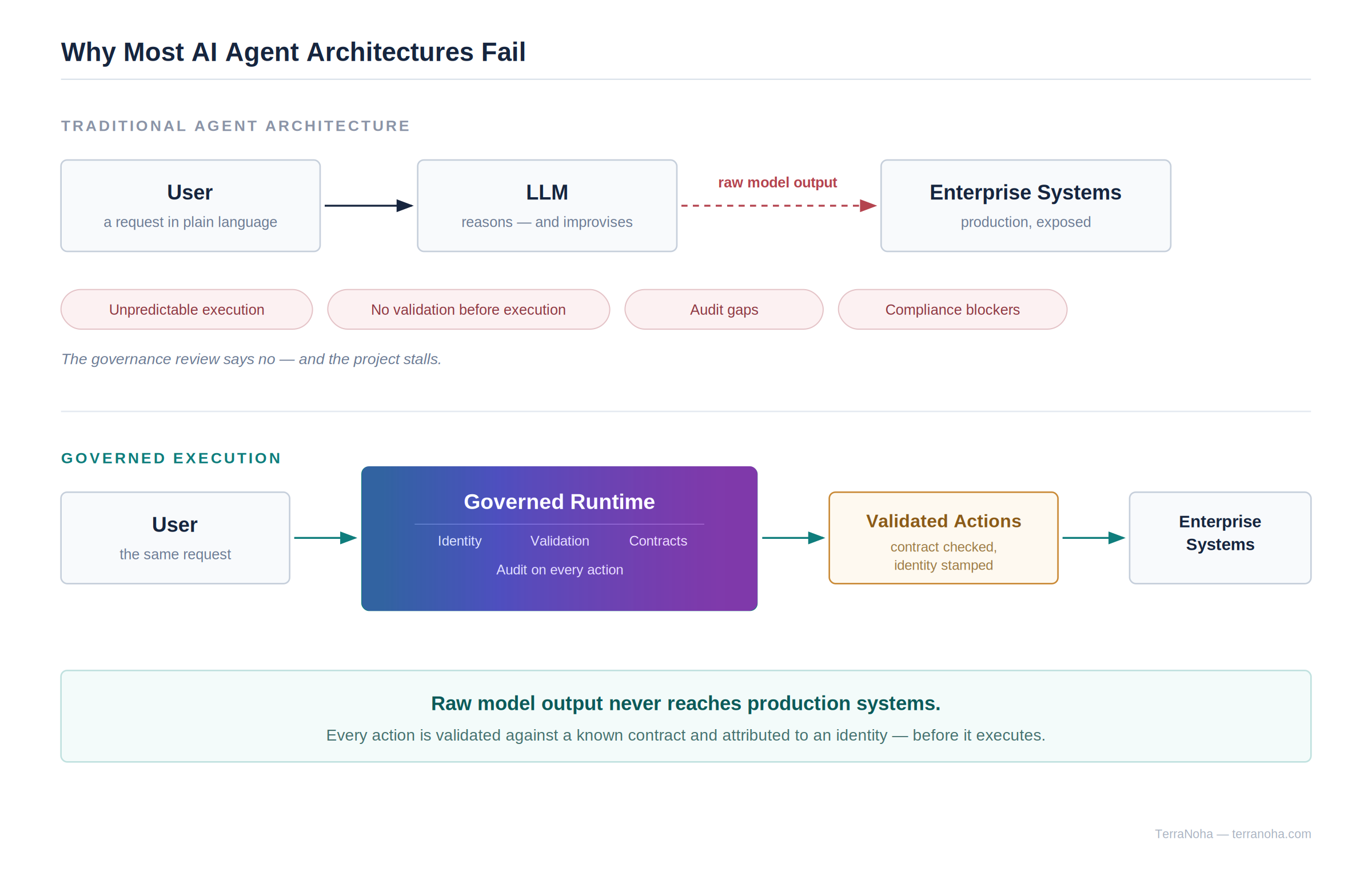
Most companies are trying to connect a probabilistic system to deterministic infrastructure, and the result is always the same: the demos look impressive, the governance teams say no, the project stalls. The pattern is now so consistent, across industries, company sizes and use cases, that it deserves to be named for what it is.
Not a maturity problem. Not a model problem.
A missing layer in the enterprise stack.
We sat down with Kiryll Pavlovich, CTO and co-founder of Terranoha, to understand what that layer is. We expected a conversation about AI safety. We got something more interesting: an argument that the most important layer in enterprise AI is not the model at all, and that what large organisations actually need looks less like a chatbot and more like an operating system.

Why enterprise AI agents fail in production
Kiryll has watched the same movie many times.
“The pilot starts with enthusiasm. The model summarises documents, answers questions, drafts emails. Everyone is impressed. Then someone asks the obvious next question:
Can it actually do something?”
In an enterprise, “something” is never abstract. It means creating a record in a system of record, approving a request, updating a limit, issuing an instruction to a downstream system. Real actions, on real systems, with real consequences.
“And that is where everything stops,” he says.
“Every governance review eventually asks the same question: what exactly will this thing send to our systems? With a standard LLM setup, the honest answer is, we don’t fully know. The model improvises. That is its nature. It is what makes it extraordinary with language, and exactly what makes it unacceptable in front of a production system.”
He is blunt about it.
“We have yet to meet a large organisation willing to let raw model output reach a production system. Not one. And they are right.”
The uncomfortable conclusion: most stalled AI agent projects did not fail because the model wasn’t smart enough. They failed because nobody could sign off.
“In our meetings, the first thirty minutes are about what the model can do,” Kiryll adds.
“The next two hours are about whether anyone can ever let it.”
Reason freely, never execute freely
Ask Kiryll what the fix is and he does not say better guardrails, or a smarter model. His answer is more radical:
“AI should reason freely. It should never execute freely.”
The model, in his view, should never be allowed to invent an action against a production system. Not constrained. Not supervised. Never allowed.
“The model is allowed to think probabilistically. The platform is not allowed to behave probabilistically. Those are two different worlds, and the biggest mistake in enterprise AI right now is letting them touch directly.”
Most people think the challenge is intelligence. It isn’t. “Most AI vendors are selling intelligence,” Kiryll says.
“Enterprises do not need more intelligence. The models are already smarter than the integration around them. What they need is governed execution. The problem was never getting AI to think. The problem is getting AI to act safely.”
The alternative is an old engineering idea applied to a new problem: a contract. A deterministic interface sits in front of every system and declares, in machine-readable form, exactly which actions exist, which parameters each accepts, and what is allowed. The model stops inventing calls. It selects from a known contract.
“That one decision changes everything. If every possible action is known in advance, you can validate every action before it runs. You cannot validate what you cannot predict. So we made everything predictable.”
Governance as structure, not as promise
“AI governance” is on every vendor slide this year. Kiryll is unimpressed by most of it.
“What you usually see is governance as a promise. Guardrails, system prompts, a policy PDF. That’s hoping the model behaves. Hope is not an architecture.”
What he advocates instead is governance as structure: properties that hold on every call because the system is built that way, not because the model was asked nicely. Every system action is validated against the contract before it runs; if the parameters on an instruction are wrong, the instruction simply doesn’t happen, which means there is nothing to clean up and nothing to explain to an auditor afterwards. Identity travels with every message, not just at login, and is attached to every action, so every action is attributable. And everything lands in the audit trail: every request, every validation, every execution.
His test for any enterprise agent platform is short.
“Ask what exactly the AI sends to your systems, and whether it can be validated before it executes. If raw model output ever reaches a production system, the architecture is wrong. Everything else is detail.”
The governed runtime: an operating system for enterprise agents
This is where the conversation stopped being about AI safety and became about something bigger.
The plain-language version first. A governed runtime is the controlled execution layer that sits between an organisation’s people and its real systems. It receives requests in plain language, validates what can be done, stamps identity and executes safely. Every time, for every workflow.
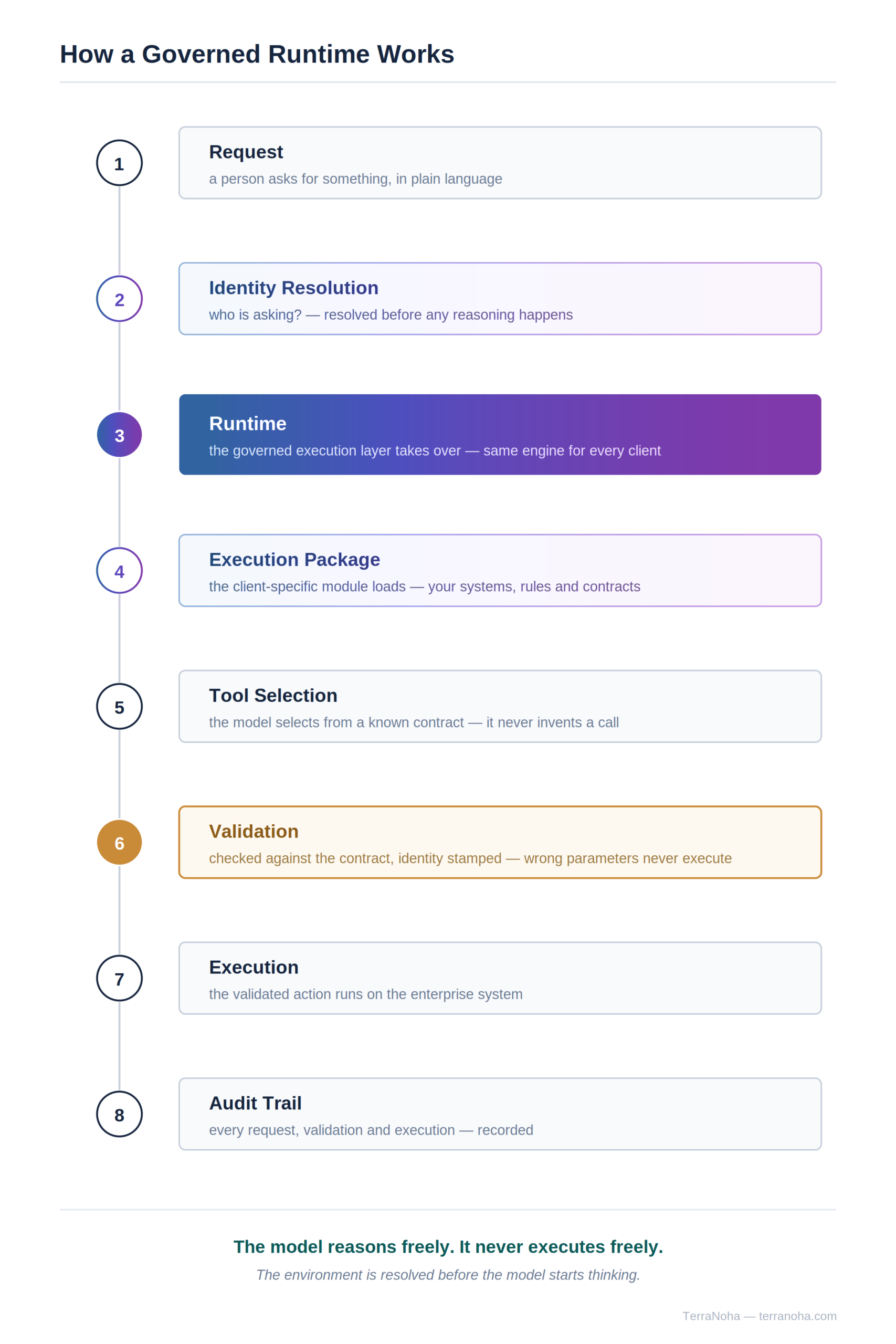
“When a request enters the platform,” Kiryll explains, “the first question is not, what should the AI do? The first question is: who is asking?”
Identity, it turns out, is not a security checkbox in this architecture. It is the organising principle of the entire platform.
“The model never discovers tools. The runtime decides which tools exist before the model even starts reasoning.”
Consider what actually happens when a request enters the platform. Most people imagine the model immediately searching for tools, exploring what it can do. The opposite happens. Before the model reasons about anything, the runtime resolves identity, determines the client context, loads the appropriate execution package, defines which tools exist, selects the memories that are reachable, and applies the workflow contracts that govern execution. Only then does the model begin to think.
The model does not discover its environment. The environment is resolved before the model starts thinking.
The agent wakes up inside a sealed, client-specific world, its tools, data, vocabulary and permissions already determined by identity. One client can never, structurally, reach another client’s systems or data.
“At that point you realise what you’re actually building,” Kiryll says.
“Process isolation. Identity management. Resource access control. Module loading. Scheduling of synchronous and asynchronous work. Auditing. These are not chatbot features. They are the responsibilities of an operating system. An operating system for enterprise agents, where execution packages are the applications and the kernel never trusts a process.”
It is an analogy, he concedes, but one that holds up: every classic operating-system responsibility has a direct equivalent in the platform. It also explains why TerraNoha’s view of its own product is the inverse of the market’s:
“Most people think the agent is the product. We believe the runtime is the product. Models will change every few months. The execution layer cannot.”
MCP is a protocol, not an enterprise agent platform
No conversation about AI agent infrastructure in 2026 avoids MCP, the open protocol for connecting AI models to tools and data. TerraNoha builds on it, which makes Kiryll’s assessment of it more interesting, not less.
“Everyone talks about MCP. Almost nobody understands what it does and doesn’t give you. MCP standardises access. That’s all. And that’s a lot.”
But standardised access, he argues, is the easy part. MCP does not address governance, identity, multi-tenancy, lifecycle management, versioning or deployment. Those responsibilities sit entirely outside the protocol.
“Enterprises do not struggle because tools are hard to connect. They struggle because execution is hard to govern. MCP tells an agent how to talk to a tool. It says nothing about who may act, on what, under which contract, with what audit trail, in which client’s isolated world.”
His summary deserves a place in every architecture review this year:
“MCP is a protocol. Enterprise execution requires an operating system around it.”
Then he reaches for an analogy.
“Connecting an MCP server to a model and calling it an enterprise agent platform is like connecting a network card to a motherboard and calling it a computer.”
“We automate the automation”
If the governed runtime is the operating system, where do the applications come from? This is the second half of Terranoha’s thesis, and to understand it you have to take the company’s internal motto more seriously than a motto usually deserves: we automate the automation.
It sounds like a tagline. It describes a different production model.
For decades, enterprise automation has worked one way: humans build it. Analysts specify, developers code, testers test, and months later something ships. Once, for one client. Every improvement is more human work, and the second automation costs roughly as much as the first.
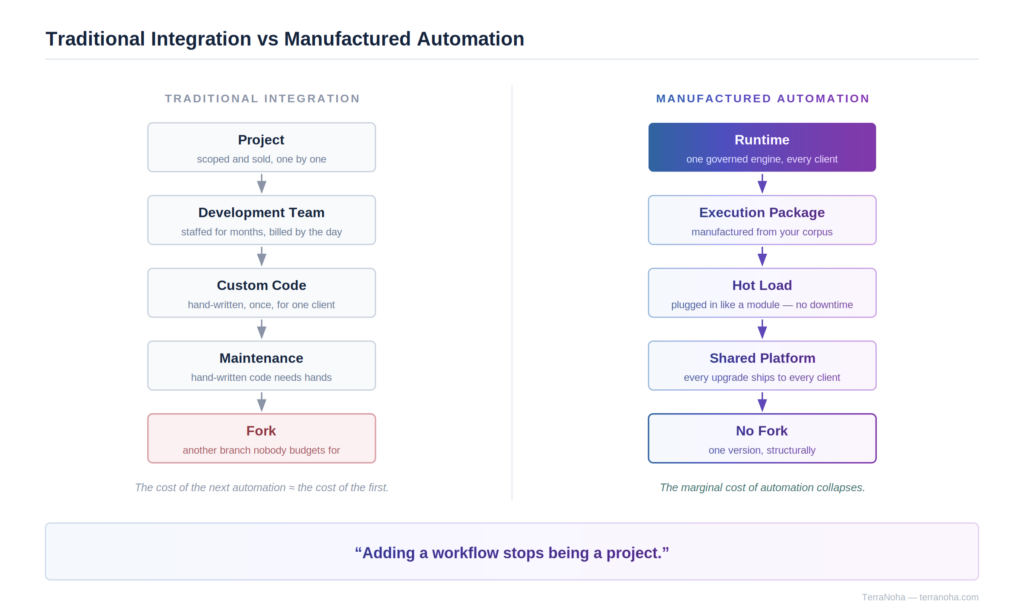
Terranoha inverts this. Its Onboarding Studio, an internal factory that clients never touch, ingests an organisation’s onboarding corpus: API specifications, business workflows, rules, vocabulary, test scenarios, security constraints. From that corpus it manufactures the execution package: the system contracts, the action handlers, the prompts and rules, the identity mapping. Everything that makes the generic runtime work with that particular organisation’s world. The client’s experts then refine the package live, in conversation; a missing field is added and tested in the next sentence, with no redeploy and no sprint.
Discipline does the rest. Every package builds against one shared runtime version (Kiryll’s rule here is, in his own words, almost religious) and is hot-loaded into the running engine like a module. No downtime. No fork.
“The factory is not the product. Clients never see it,” he stresses. “But it is why the economics work. When the engine is generic and the application layer is manufactured, the marginal cost of automation collapses.”
And then comes the sentence that carries the most disruptive idea in the conversation:
“Adding a workflow stops being a project.”
A different economic model
That sentence has a target, and it deserves to be spelled out.
Traditional enterprise integration economics rest on projects, delivery teams, hand-written customisation, maintenance contracts and version divergence. Every automation is scoped and sold as a project. Teams are staffed for months and billed by the day. The code is written once, for one client. It then needs hands to maintain it. And every project leaves behind another branch of the platform.
Kiryll often asks prospects a simple question: how many versions of your integration platform are currently running? The answers are rarely comfortable. Three. Seven. One global organisation admitted it had lost count.
“Every custom project introduces another branch. Another exception. Another maintenance burden nobody budgets for. This is how enterprise software slowly dies. Not with a crash, but with a fork.”
Here is the part that is easy to miss: the fork problem is not a bug of the traditional model. It is the business model. Divergence creates dependency; dependency creates revenue.
Now invert each element. One governed runtime instead of a platform per project. Manufactured execution packages instead of delivery teams. Hot-loading instead of deployment projects. No forks, structurally. And shared platform evolution, where every improvement ships to every client at once, so reliability compounds across the whole client base instead of fragmenting.
The point is not that this is a better integration methodology. It is a fundamentally different economic model. In the traditional model, the integrator’s revenue grows with the client’s complexity. In the manufactured model, the platform’s value grows with the client’s simplicity: every new workflow becomes another execution package, not another platform project.
Kiryll is careful not to overclaim. Connectivity, identity setup and the client’s security review still happen. “Once,” he notes. “After that, growth is adding packages.”
The losers of enterprise AI may not be the organisations that adopted it too slowly. They may be the ones selling integration by the month.
What happens next
The industry is still focused on models, and that is understandable. Models are visible. They improve every few months, and every release generates headlines.
But models are becoming the least differentiated layer of the stack. Most enterprises will soon have access to roughly the same intelligence, which means the real question is no longer how smart the model is. The real question is whether the model can safely operate the business.
That is not a model problem. It is an execution problem, a governance problem, an infrastructure problem. It will not be solved by another model release. It will be solved by the layer that sits around the model.
“The winners of enterprise AI will not be the companies with the smartest models,” Kiryll says.
“They will be the companies that make those models safe enough to run business-critical workflows.”
Which is why the organisations that understand this moment are asking a different question entirely.
They are not asking how to deploy an LLM.
They are asking how to build an operating system for AI.