





Enterprise Operations Are Driven by Exceptions
Enterprise operations don’t break because of standard workflows.
They break when something unexpected happens.
Typical examples include:
- A missing allocation
- A settlement mismatch
- An incomplete trade confirmation
- A pricing discrepancy
- A failed approval
- A document arriving with missing information
These aren’t edge cases.
They’re part of daily operations.
Yet most automation platforms are designed for predictable workflows, where:
- every input is available;
- every business rule is known in advance;
- every process follows the expected path.
Enterprise operations rarely work that way.
The real challenge isn’t automating routine tasks.
resolving the exceptions that prevent work from moving forward.
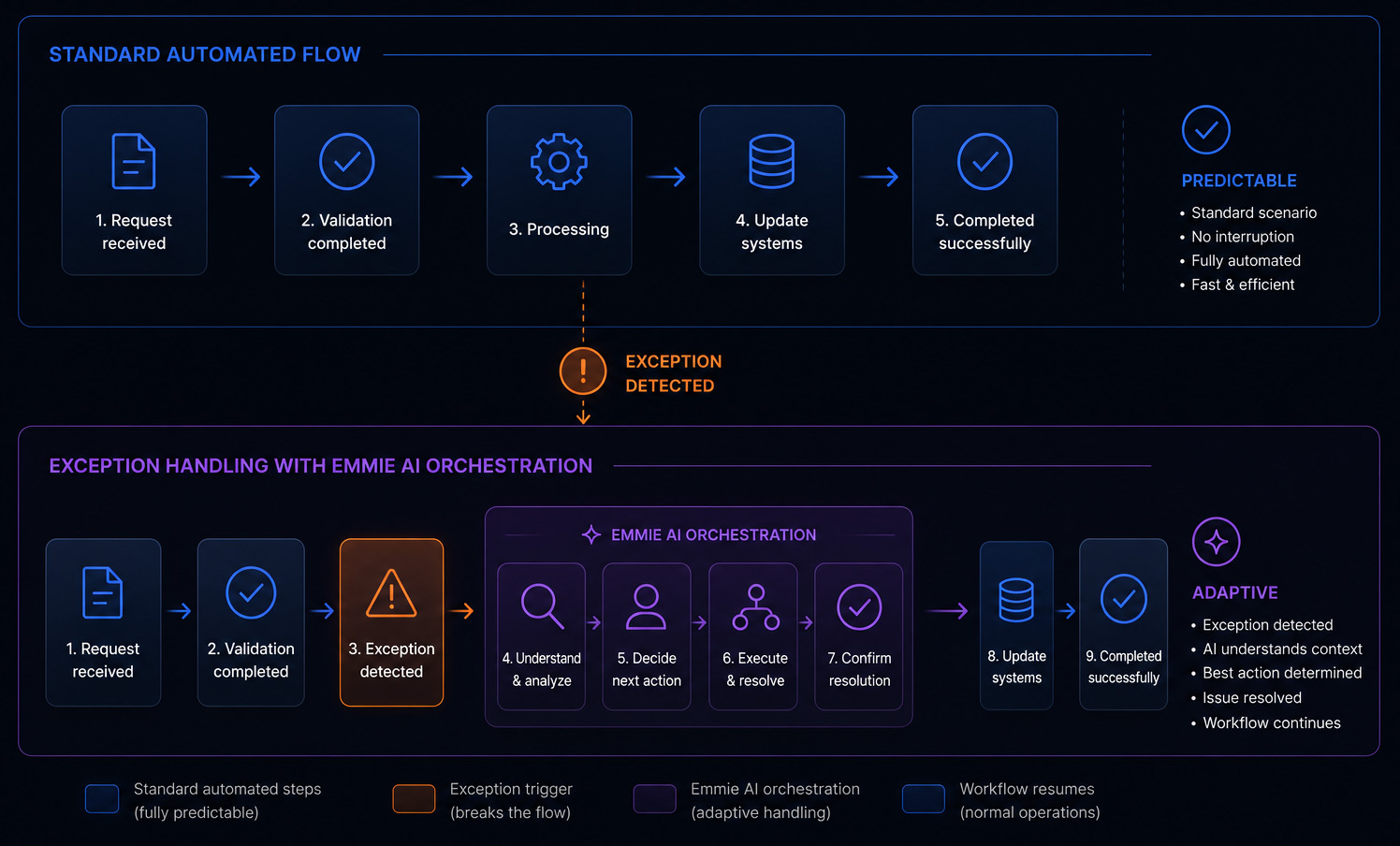
The Hidden Cost of Operational Exceptions
When an exception occurs, the workflow usually stops.
- Someone receives an email.
- Another person searches several systems.
- Someone else checks internal procedures.
- A manager approves the decision.
- Operations manually update the platform.
One exception can involve five people, multiple applications, and dozens of emails.
Multiply that by hundreds of cases every week, and exceptions become one of the largest sources of operational inefficiency.
The issue isn’t complexity. It’s fragmentation.
Why AI Alone Doesn’t Solve the Problem
Modern AI can recognize an exception almost instantly.
It can classify the issue, extract relevant information, and even suggest the appropriate resolution.
But recognition is only the beginning.
Enterprise environments require answers to much harder questions:
- Is this action authorized?
- Which policy applies?
- Does the exposure exceed a predefined threshold?
- Should a human approve this decision?
- Which systems must be updated?
- What evidence should be recorded for audit purposes?
Without governance, AI simply shifts the bottleneck from understanding to execution.
A Governed Approach to Exception Resolution
This is where Operational AI becomes different.
Instead of simply notifying users that something went wrong, Emmie orchestrates the entire resolution process.
She can:
- detect the exception across emails, chats, or enterprise systems;
- collect missing information automatically;
- apply business rules and validation policies;
- determine whether escalation is required;
- trigger authorized actions inside connected platforms;
- maintain a complete audit trail for every decision.
The objective is not to eliminate human involvement.
It is to involve the right person only when judgment is actually required.
From Reactive Operations to Controlled Execution
Exception handling should not rely on inbox monitoring and manual coordination.
It should become an orchestrated operational process.
By combining AI reasoning with governed execution, organizations reduce response times, improve operational consistency, and strengthen compliance without sacrificing control.
As enterprises move beyond conversational AI, competitive advantage will not come from generating better answers.
It will come from resolving operational exceptions faster, more safely, and with complete traceability.
Because in enterprise operations, the real value of AI isn’t measured by how often everything goes right.
It’s measured by how effectively it handles everything that doesn’t.