



What Lies Beneath
Deploying AI in a real business environment requires much more than a capable model.
Organizations need answers to questions such as:
- How are permissions managed?
- Who can approve critical actions?
- How are decisions audited?
- How are policies enforced?
- How are workflows orchestrated across multiple systems?
These capabilities are rarely highlighted during demonstrations, yet they often determine whether an AI initiative can be deployed safely and successfully.
The Importance of the Runtime Layer
At Terranoha, we believe the most important layer in enterprise AI is not the model itself.
It is the runtime.
The runtime provides the foundation that allows AI agents to operate within the rules, controls, and governance requirements of an organization.
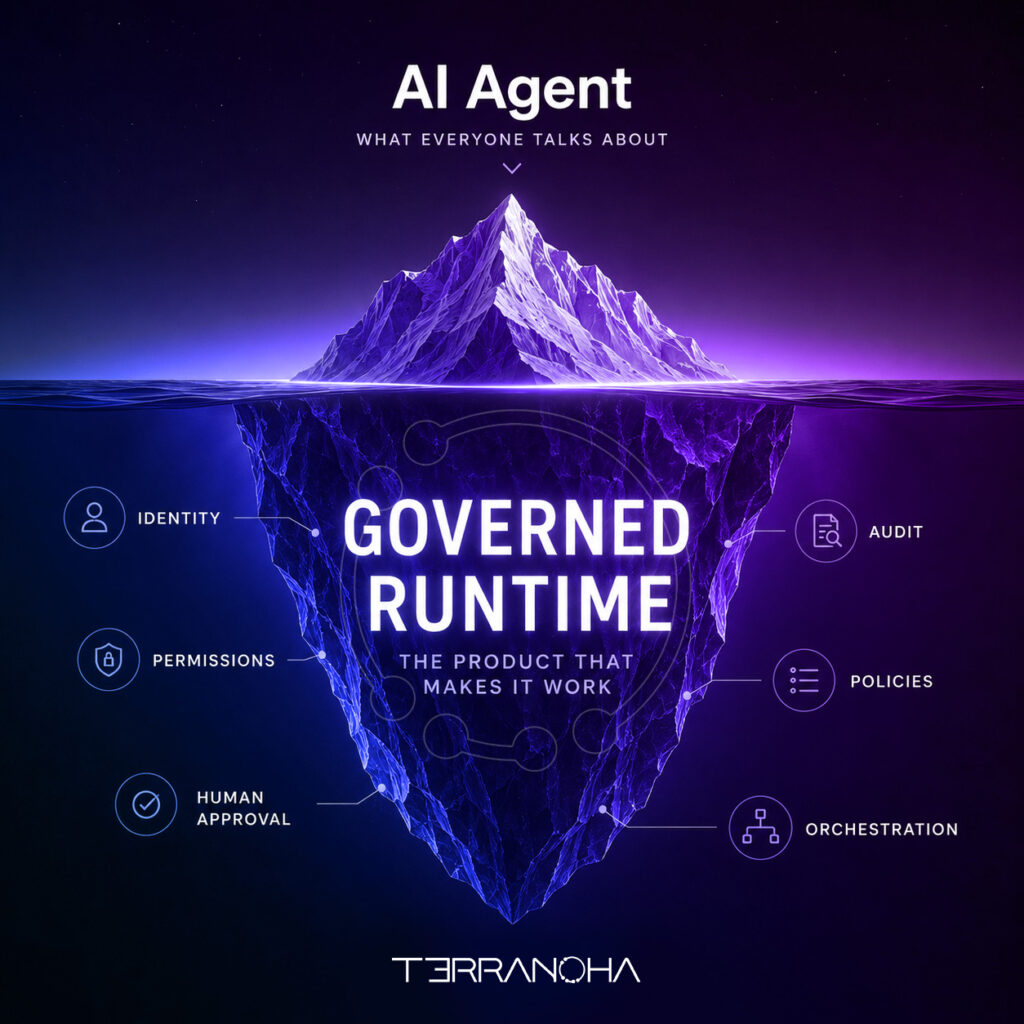
This layer typically includes:
- Identity and access management
- Permission enforcement
- Human-in-the-Loop validation
- Auditability and traceability
- Workflow orchestration
- Policy management
- Security and compliance controls
Without these capabilities, even the most advanced AI agent remains difficult to deploy in production environments.
Moving Beyond AI Demos
AI demonstrations often showcase what an agent can do.
Production environments require organizations to understand how the agent operates.
The difference may seem subtle, but it is critical.
An impressive AI demonstration proves intelligence.
A governed runtime enables execution.
The Future of Enterprise AI
As AI continues to evolve, the conversation is gradually shifting.
Less attention is being placed on model capabilities alone.
More attention is being placed on governance, control, accountability, and operational reliability.
The organizations that succeed with AI will not simply deploy smarter agents.
They will build the infrastructure required to operate those agents safely, reliably, and at scale.
The agent may be the visible part of the iceberg.
The runtime is what keeps it afloat.